
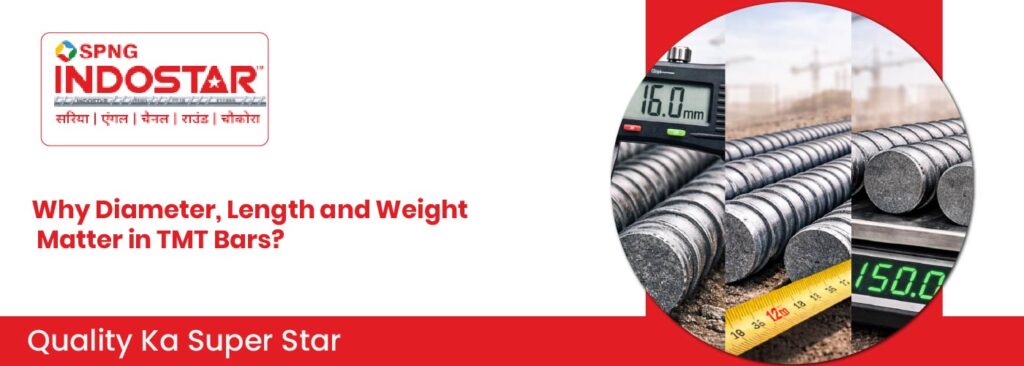
Understanding the Importance of TMT Bar Dimensions
When builders purchase TMT bars, the most common focus is on price or brand. However, one critical factor often overlooked is the accuracy of diameter, length, and weight.
These three parameters play a major role in determining whether a structure will remain strong and stable for decades.
Even small deviations in steel dimensions can significantly affect the load-bearing capacity of beams, columns, and slabs.
For a broader understanding of selecting the right steel, you can also read
The Ultimate Guide to Choosing TMT Bars for Construction in North India.
What Does Diameter Mean in TMT Bars?
The diameter of a TMT bar refers to the thickness of the steel rod, usually measured in millimeters.
Common diameters used in construction include:
- 8 mm
- 10 mm
- 12 mm
- 16 mm
- 20 mm
- 25 mm
Different diameters serve different structural purposes.
For example:
- 8 mm and 10 mm bars are often used in slabs.
- 12 mm and 16 mm bars are used in beams and columns.
- 20 mm and above are used in heavy load-bearing structures.
If the diameter is smaller than specified in structural drawings, the building may lose a significant portion of its structural strength.
Why Correct Length of Steel Bars Matters
Steel bars are usually manufactured in standard lengths of 12 meters.
Maintaining this length helps ensure proper reinforcement placement across the structure.
Shorter bars create more joints and overlaps, which may weaken structural stability if not handled properly.
Proper length ensures:
- Fewer joints in reinforcement
- Stronger bonding with concrete
- Better load distribution
This contributes directly to the durability of the structure.
The Role of Weight in Structural Strength
Weight is directly linked to the amount of steel present in a bar.
Each diameter has a standard theoretical weight.
For example:
| Diameter | Approx Weight per Meter |
| 8 mm | 0.395 kg |
| 10 mm | 0.617 kg |
| 12 mm | 0.888 kg |
| 16 mm | 1.58 kg |
If a bar weighs significantly less than these standards, it may contain less steel material, reducing its strength.
This can lead to structural risks over time.
Impact on Structural Load Calculations
Structural engineers design buildings based on precise calculations.
These calculations assume:
- Correct steel diameter
- Accurate steel weight
- Standard reinforcement placement
If the steel used does not match these specifications, the entire load distribution of the structure changes.
This can lead to:
- Beam cracks
- Column stress
- Structural instability
Safety and Compliance in Construction
Construction safety depends on strict adherence to engineering standards.
Builders must verify steel specifications before using them in reinforcement work.
Reliable manufacturers ensure that:
- Diameter accuracy is maintained
- Weight standards are followed
- Manufacturing quality remains consistent
To understand why steel quality matters in foundations, you can also read Strong Foundation Steel Bars.
The Cost vs Quality Debate
Many contractors choose cheaper steel to reduce project costs.
However, lower-cost steel often achieves savings by reducing:
- Diameter accuracy
- Material content
- Manufacturing quality
While this may reduce immediate costs, it can increase long-term maintenance and repair expenses.
Investing in correct steel specifications ensures durable and safe construction.
Conclusion
Diameter, length, and weight may appear to be small technical details, but they have a huge impact on structural safety.
Accurate steel specifications ensure that buildings can withstand loads, environmental stress, and long-term usage.
By choosing steel that meets proper standards, builders can ensure that their structures remain safe, stable, and reliable for decades.
FAQs
1. Why is diameter important in TMT bars?
Diameter determines the load-bearing capacity of the reinforcement steel.
2. What is the standard length of TMT bars?
Most TMT bars are manufactured in standard 12-meter lengths.
3. Why should builders check steel weight?
Weight verifies the amount of steel content and ensures structural strength.
4. Can smaller diameter steel be used to reduce cost?
No. Using smaller diameters can compromise structural safety.
5. Who decides the diameter used in construction?
Structural engineers determine the appropriate diameter based on load calculations.